About this blog

This blog will consist of my personal literary reviews of poetry books for a TWU graduate class, Poetry for Children and Young Adults.

Monday, March 3, 2014

A Poke in the I

A Collection of Concrete Poems
Selected by Paul B. Janeczko

Janeczko, Paul B., comp. A Poke in the I. Illustrated by Chris Raschka. Cambridge, MA: Candlewick Press, 2001. ISBN 0763606618


This book is a collection of 30 concrete poems written by visual poets and selected by Paul B. Janeczko. Each poem has been used in another published text, but was selected because of its style and concrete nature to be part of this book. When Janeczko puts together a book focusing on concrete poems he does not disappoint. Every piece of text in this book is written in concrete form, including the title page verso and notes from the editor. The notes from the editor content is arranged like the sounds coming out of a saxophone, and teach the reader about the form of concrete poetry. Janeczko goes all out and even writes his table of contents in the shape of a table. Each item in the table of contents is listed by the poem title, poet, and page number. There does not seem to be a particular reason for the arrangement of the poems. Readers will easily be able to locate certain poems through the table of contents, and they will be able to find their original sources with the acknowledgement pages in the back of the book.

Chris Raschka's illustrations are original and imaginative. His artistic style includes a mixture of watercolors and torn paper collages. The illustrations are extremely important to this book because they play a major role in the poem's structure. Some of the poems only contain one word, so the illustration helps the reader connect to the poem. Raschka does a great job in not overwhelming the reader with illustrations by having a white background so the text and art can stand out. While the focus of this book is concrete poems, readers will still experience all sorts of sounds and figurative language, particularly will alliteration consonance, assonance. Readers will have fun reading this book in class or for entertainment. They will also enjoy the multiple ways to display and read poems. The intended audience for this book is children ages eight to fourteen years old. This book will make a positive addition to a classroom or library collection. 

The poem I have selected to highlight for a poetry break is "Tennis Anyone?". In the book, this poem is written on two pages and a line is drawn between the two to represent a tennis ball going back and forth in a tennis game. A fun way to present this poem would be to have two students on opposite sides of the room toss a tennis ball back and forth. The students will recite their lines of the poem when they have the ball. Students will be engaged by the movement and actual interaction in the presentation of the poem. Below is the poem, but keep in mind that it has more power when accompanied by illustrations or an appropriate presentation.

Tennis Anyone? 
by Monica Kulling

Tennis                                                   is a
game I                                                  could watch
for hours                                               but my
neck won't                                            let me


Sunday, March 2, 2014

Forest Has a Song

Poems by Amy Ludwig VanDerwater

VanDerwater, Amy Ludwig. Forest Has a Song. Illustrated by Robbin Gourley. New York, NY: Clarion Book, 2013. ISBN 9780618843497


This book is a colorful collection of 26 poems written by one poet, Amy Ludwig VanDerwater. Each of the 26 poems is strong enough to be used independent of this book, but when they are kept together they tell a beautiful story. The theme of this book is a forest. Every poem either has a connection to the forest or is the forest whispering. The poems will give readers a chance to listen to what the forest has to say as it invites a little girl and her dog to visit. Along the journey through the forest, readers will experience all sounds, rhythms, and uses of figurative language. Readers will easily make a connection to the forest. VanDerwater provides just enough emotional impact with this feel good book of poems. To allow readers to easily identify when a poem has different voices, VanDerwater uses italic lettering to distinguish who is speaking. This book is geared toward elementary and middle grade children as the intended audience.


The illustrations done by Robbin Gourley are beautiful. Gourley is represented on every single page of the book, from patterns of different colored leaves on the inside front and back covers, to an illustration for every poem, to a solid color painted blank page. Gourley's artistic style and use of watercolors is delicate and realistic. The illustrations and poems are perfectly matched, and each illustration definitely enhances the power of the poem. The layout of this book is simple and only contains illustrations and poetry. There is no table of contents, index, or reference page to find individual poems by. I would definitely recommended this book for libraries who serve children and young adults.


One poem I would highlight from this book to use in a poetry break is "April Walking". I chose this short poem because it packs a punch with alliteration and a touch of end rhyme. One way to integrate this poem into a lesson is in a speech or theater class. To assist with public speaking students recite sayings to help them not to get tongue tied. As a warm up, students will read this poem aloud several times. This poem is fun to read because it can twist the tongue. This could also be used in a reading classroom to take a mental break from serious work. 

April Waking

by Amy Ludwig VanDerwater


Ferny frondy fiddleheads
unfurl curls from dirty beds.
Stretching stems they sweetly sing
greenest greetings sent to Spring.

Saturday, March 1, 2014

Stop Pretending

What happened when my big sister went crazy
by Sonya Sones


Sones, Sonya. Stop Pretending : What Happened When My Big Sister Went Crazy. New York, NY: Harper Collins, 1999. ISBN 0439250706


This novel is a collection of free-verse poems all written by one poet, Sonya Sones. This novel is an exploration through a young girl's life as she deals with the hospitalization of her older sister for mental health reasons. Each poem is a stepping stone through her emotional roller coaster during a difficult time in her life. Some of the poems are simple transitions between events, while others have deep meaning and presence in the story. The poems in this book were meant to be used together to explain the story Sones has to tell. This novel is not overly sentimental, but it does contain serious and emotional subject matter. Readers may empathize or sympathize, but they will definitely have some kind of emotional connection to this story. There are happy, serious, and depressing moods that are exhibited through the poems. In Sones' free-verse poems there is not a prominent sound or rhythm. She mainly writes with emotional impact and a touch of figurative language and sense imagery. The intended audience for this novel is females grades six through nine.

The layout of the book is important to the story that is being told. The only illustration for this book are the three pictures on the dust jacket. The pictures display blurry images of a female with a camera. Two of the pictures are the same image. Before the story beings, the author provides an acknowledgements page where she gives thanks to the people who guided and supported her in the journey of writing this novel. There is not a table of contents or index to help readers find individual poems. However, there is an author's note in the back of the book that gives the readers an insight into Sones' motivation in writing this novel. In this note, Sones writes about the preceding and resulting events of the story. In her conclusion, Sones offers resources on seeking help for mental health problems for yourself or someone you may know by listing helpful company names and phone numbers. This is a great novel to open people's awareness to mental health disorders, and how a whole family is affected by this disease. I would recommended this book for school and public libraries.

When thinking about how I would integrate this book into a lesson I decided that I would like to do a unit on the book, but have little activities and extension with certain poems. One of those poems would be "Minus". I chose this poem mainly for the last stanza in the poem. After reading the poem aloud together and then silently on their own, the student will give their interpretation of "4-1=0". Students will write their thoughts on a post it before they leave class as an exit ticket. The next day the teacher will have arranged the common interpretations and present them to the class. 

Minus
by Sonya Sones

Last night
Sister wasn't there
to help me study for my math test.

Father tried to fill in
but he's never been as good at math
as her.

This morning
I'm sitting here
taking the test

but the numbers on the page
keep scrambling
in my head

and the only equation
I really understand is:
4 - 1 = 0.


Tuesday, February 18, 2014

Comets, Stars, The Moon, and Mars


Space Poems and Paintings
By Douglas Florian
Florian, Douglas. Comets, Stars, the Moon, and Mars : Space Poems and Paintings. Orlando, FL: Harcourt, 2007.
ISBN 9780152053727

This book is a wonderful collection of space poems and paintings all created by author Douglas Florian. This is a perfect book to help reinforce space concepts in the science classroom.

The illustrations in this book are creative and a little abstract. Florian uses a combination of artistic styles to create the backgrounds of each page and poem. Each poem has a specific illustration filling up two pages and the poem is presented on one of the pages. Florian's interesting techniques definitely aide in enriching the content of each poem, and providing a helpful visual for readers. The book's layout is fairly straight forward with a table of contents in the front, and a glossary, selected bibliography, further reading, and title page verso in the back. The "Galactic Glossary" is extremely important to have when trying to teach real life concepts to young people. The only time the reader will see page numbers is on a page that holds a poem, and the page numbers are placed on the sides of the pages. This is not a traditional method of numbering pages but it is unique.

The consistency of this book is in the connection to space, and every poem has some sort of rhyming pattern. Each poem teaches readers about a single planet or space vocabulary word. Readers will experience humor, enjoyment, and knowledge as they read or have the poems read to them. One poem that stands out from the rest is "A Galaxy" because it is written as concrete or shape poetry. The words of the poem are displayed in a spiral, similar to a spiral of a black hole. Students will find this poem very interesting to read. All poems are short and sweet. They entertain the reader with end rhyming patterns and figurative language.

This book would be a positive addition to any library that serves children and young adults. I would recommend this book to all elementary science teachers to use in conjunction with space lessons. For example, a science teacher could read this book to introduce all the planets in our solar system. It will definitely enrich the student's learning.

It is really hard to pick just one poem to highlight from this book because they all are fabulous. The poem I would highlight is "A Galaxy". I would have this used during a poetry break. During a stopping point in an English teacher's lesson, the poem can be blown up and presented on the board or projector. The teacher will ask the students to read the poem silently and give them a little time. Then they will have a discussion on if the students had a difficult time reading the poem because of it's shape. After a little discussion the teacher or a selected student will read the poem to the class. This can lead into a lesson on concrete poems, or just be a nice little break from the busy work in class. The following is a picture of the poem written out. It doesn't not have the same effect without it's shape.

A Galaxy
by Douglas Florian


Sunday, February 16, 2014

A Maze Me

A Poem for Girls
by Naomi Shihab Nye
Nye, Naomi Shihab. A Maze Me : Poems for Girls. New York, NY: Greenwillow Books, 2005.
ISBN 0060581891

This book is a delightful collection of over 70 poems written from observations and experiences of Naomi Shihab Nye. All of the poems in this book are free verse, and they talk about life experiences of girls in childhood and teenage years. This book was written for girls ages 12 to 17 years old. Nye writes these poems like they are her own thoughts and young readers will be able to connect with poems. There is a very strong personal connection to be had when reading this book. 

This collection is simply arranged and separated by five sections. Each section is beautifully introduced with pastel-colored illustrations by Terre Maher. The beginning of the book contains a table of contents and introduction where the author talks about childhood and reminisces about school days before adulthood. She even suggests young readers to start writing three lines everyday about anything they want. She believes the reader will be able to make connections and truly learn more about who they are. This introduction really helps add to the personal touch of this book. The back of the book has an index that is a little different than most. The poems are listed by alphabetized first lines. The back cover and the inside dust jacket information are not summaries but actual poems to represent the contents of the book.

Poems in this book are not too flashy or complicated to read and understand. Some have abstract content, but the majority are descriptive and full of sense imagery, emotional impact, and figurative language. Nye writes a few poems with some rhyming features, but there is no specific rhyming patterns in her writing. She does include many metaphors and examples of personification. This is an overall pleasant book that is definitely recommended to have in any library who serves middle to high school age females.

A poem I would choose to highlight from this book would be Ellipse. As a Reading/English class warm-up, the teacher would read the poem aloud to the students. The students would then be asked to write down their impression of the poem. What came to mind as you were listening to the poem? Can you visually see punctuation marks on people? How do you feel about the poem? After a few minutes of reflection there would be a whole class discussion on the student's impression of the poem and the use of punctuation as physical markings on a person. This could also lead into a lesson on the mentioned punctuation marks and how they are normally used.

Ellipse
By Naomi Shihab Nye

My father has a parenthesis
on either side of his mouth.
His new words 
live inside his old words.
And there's a strange semicolon
birthmark on my neck-
what does it mean,
my sentence is incomplete?

Please,
live with me in the open slope
of a question mark.
Don't answer it!
Curl up in a comma
that says more, and more, and more...


Planet Middle School

By Nikki Grimes

Grimes, Nikki. Planet Middle School. New York, NY: Bloomsbury, 2011.  

ISBN 9781599902845


Nikki Grimes creates humorous and heartfelt poems to tell the story of a twelve year old girl who is going through puberty. I can't say enough good things about this book. While reading, I found myself empathizing with the main character Joylin, and it brought me back to my experiences during such an "interesting" part of a girls' life. With that being said, the target audience for this book is definitely females around 12 years and older. Adult women will enjoy the humor Grimes uses to talk about a difficult part of girls lives. This book contains several laugh out loud moments that every women is sure to enjoy.

The layout of this book is specifically arranged to tell a story with poems of events in a sequential order. There are no illustrations in this book, and the only artwork is on the dust jacket. However, the cover art is important in how the reader visualizes the main character, Joylin. The cover displays an African American girl looking up at a sky of clouds and a basketball hoop. Young readers will visualize this girl when they read through the poems, but they may not if the picture on the front was a different girl. It can be hard for young readers to hear a subtle tone of a different race. Adult readers will be able to tell the culture of the characters by the poets' dialect. This book does not contain a table of contents, index, or reference to assist the reader in finding individual poems. Each poem is distinguishable by it's personal title. At the end of the book there is an acknowledges page from the author. 

The overall quality of this book is excellent. Every poem has individual meaning, but when they are used together they walk the reader through a funny and embarrassing journey. Nikki Grimes is the the sole author of the poems in this book. She provides a good mixture of emotions and moods throughout the book. The reader will be able to put themselves in the poems and experience the embarrassment, joy, and frustration as they take on this passage of life. Each poem in the book is written in verse. There are no rhyming patterns or distinctive sound, but the poems have a nice flow and are easy to read. The main focus of poetic elements are sense imagery and emotional impact with a touch of figurative language in personification and metaphors. The story of all the poems is the major player in this book, and Grimes knows how to capture an audiences attention with her humor and honesty. This is a must read for the middle and upper grades. 

Ultimately, I believe this book would be great to use with a female book club. With poems pertaining to personal female experiences, all genders may not feel comfortable talking aloud about the topic unless they were in a comfortable setting with the same gender. One poem that I found that could be used as a reflection on middle school is Planet Middle School. Not only is it the title of this book, but it can be used as a personal reflection piece. No matter how kids act, every one of them has awkward moments in middle school. I would use this poem to aide in a short writing prompt. The group will be asked to read and reflect on the specified poem silently first, and then the teacher/sponsor or a selected student will read the poem aloud to the group. The students will then be given the following prompt, "How can you relate to this poem? In your journal, write about a moment when you felt like you didn't belong?" Let the girls know that they do not have to share anything with the group that they do not want to. Make sure no one in the group feels pressured because this could be a sensitive subject. After the group has been given sometime to reflect, ask if anyone would like to discuss what they wrote. It could really turn out to be a wonderful and enlightening discussion.

Planet Middle School
by Nikki Grimes

"It was embarrassing,"
I told KeeLee.
"I'm trying on all these
strange contraptions,
and my mom's right outside
the dressing room,
dying for a peek!"
KeeLee shrugged.
"You're growing up," she said.
"That always weirds out parents."
"Still."
"I know."
Thank God for KeeLee.
She's the only familiar thing
about this crazy school year.
Bad enough my body's
turned against me.
On top of that
everything else is new:
new school, new teacher,
new classrooms
I need a map to find.
I swear, some days
I feel like an alien,
dropped off on
Planet Middle School
by mistake.
I keep scanning the skies,
searching for that spaceship
that's gonna take me home.


Monday, February 3, 2014

Marvelous Math

A Book of Poems
Selected by Lee Bennett Hopkins

Hopkins, Lee Bennett, comp. Marvelous Math : a Book of Poems. Illustrated by Karen Barbour. New York, NY: Aladdin Paperbacks, 2001.
ISBN 0689844425

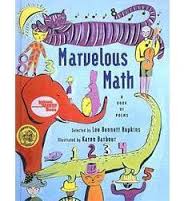
Marvelous Math is a collection of poems by various poets and selected by Lee Bennett Hopkins. The common topic of the book is all things mathematics. There are not too many books about mathematics, so this makes a great book to introduce or enrich a lesson in a math class. The layout of the book is fairly straight forward. There is a table of contents in the front and an acknowledgments page in the back of the book. The illustrations of this book are interesting and abundant. Karen Barbour, the illustrator, used a lot of vibrant colors in her drawings throughout the book. There is a question about what some of the illustrations have to do with the poems. I also think that the illustrations overpower the majority of the poems. It is hard to concentrate on what the poem is saying when there is so many other distractions on the page. Students will definitely overlook the poems and just look at the illustrations.
Over ninety percent of the poems in this book have some sort of rhyming scheme. Some of them have distinctive patterns, like every second and fourth line in each stanza where other poems have no pattern to the rhyming. One poem with an A B rhyming pattern that caught my attention teaches the reader how to count from one to ten in Cantonese. I also believe that the last poem of the book was places well because it is memorable. Over half of the poem consists of many lines of alliteration by listing names of birds and ends with the poem forming shape. Overall, this collection has potential for entertainment and content. It has a great way of connecting and teaching in the English/Reading and Math classrooms.
When selecting a poem to use in a lesson, I chose Time Passes by Ilo Orleans. I suggest this poem to be used to introduce time in a math class. This poem can be a good way for students to learn and remember seconds, minutes, and hours of time.

Time Passes by Ilo Orleans

Sixty seconds
Pass in a minute.
Sixty minutes
Pass in an hour.
Twenty-four hours
Pass in a day--
And that's how TIME
Keeps passing away!