About this blog

This blog will consist of my personal literary reviews of poetry books for a TWU graduate class, Poetry for Children and Young Adults.

Monday, February 3, 2014

Marvelous Math

A Book of Poems
Selected by Lee Bennett Hopkins
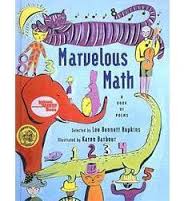
Hopkins, Lee Bennett, comp. Marvelous Math : a Book of Poems. Illustrated by Karen Barbour. New York, NY: Aladdin Paperbacks, 2001.
ISBN 0689844425

Marvelous Math is a collection of poems by various poets and selected by Lee Bennett Hopkins. The common topic of the book is all things mathematics. There are not too many books about mathematics, so this makes a great book to introduce or enrich a lesson in a math class. The layout of the book is fairly straight forward. There is a table of contents in the front and an acknowledgments page in the back of the book. The illustrations of this book are interesting and abundant. Karen Barbour, the illustrator, used a lot of vibrant colors in her drawings throughout the book. There is a question about what some of the illustrations have to do with the poems. I also think that the illustrations overpower the majority of the poems. It is hard to concentrate on what the poem is saying when there is so many other distractions on the page. Students will definitely overlook the poems and just look at the illustrations.
Over ninety percent of the poems in this book have some sort of rhyming scheme. Some of them have distinctive patterns, like every second and fourth line in each stanza where other poems have no pattern to the rhyming. One poem with an A B rhyming pattern that caught my attention teaches the reader how to count from one to ten in Cantonese. I also believe that the last poem of the book was places well because it is memorable. Over half of the poem consists of many lines of alliteration by listing names of birds and ends with the poem forming shape. Overall, this collection has potential for entertainment and content. It has a great way of connecting and teaching in the English/Reading and Math classrooms.
When selecting a poem to use in a lesson, I chose Time Passes by Ilo Orleans. I suggest this poem to be used to introduce time in a math class. This poem can be a good way for students to learn and remember seconds, minutes, and hours of time.

Time Passes by Ilo Orleans

Sixty seconds
Pass in a minute.
Sixty minutes
Pass in an hour.
Twenty-four hours
Pass in a day--
And that's how TIME
Keeps passing away!

Sunday, February 2, 2014

Hip Hop Speaks to Children

A celebration of poetry with a beat 
Edited by Nikki Giovanni

Giovanni, Nikki, ed. Hip Hop Speaks to Children : a Celebration of Poetry with a Beat. Illustrated by Kristen Balouch, Michele Noiset, Jeremy Tugeau, Alicia Vergel de Dios, and Damian Ward. Naperville, IL: Sourcebooks Jabberwocky, 2008. 
ISBN 9781402210488

Hip Hop Speaks to Children is an amazing collection of notable poets and artists like Kanye West, Nikki Giovanni, Langston Hughes, Queen Latifah, Walter Dean Myers, Martin Luther King Jr., and Maya Angelou. The book comes with an audio CD that contains vocal representation of many of the poems. Some of the poems are simply read aloud by the poet, while others are performed by an artist. After reading the book alone, and then reading it again with the audio CD, I recommend using the CD. While all the poems have something special, they can be difficult to read because of the dialect and language. That is where the audio comes in handy. It provides a bridge between what the artists is trying to say and the reader in understanding the message. Listening to the emotion of the artists speaking, singing, or rapping allows readers to feel and experience the poems the way they were meant to be. 
This book will appeal to all ages of people, but it is geared toward the upper elementary and middle school student though content, illustration, and tone. Every page of the book has an illustration that enhances the poems in a visual artistic way. They are colorful, meaningful, and on a few pages over powering of the poem.  Particular illustrations have too much going on in the drawing that the poem does not seem to be the center of attention. This book has many illustrators with different and distinctive artistic style. The many illustrators and many poets gives all readers a nice variety of styles and forms. With fifty-one poems in this collection there are many poetic elements used for meaning, rhythm, sound, figurative language, sense imagery and emotional impact. There are examples of meter and patterns in the rhythm of the different poems. The main sounds of the book are rhyming and alliteration. The figurative language of the poems stands out in similes and metaphors. Every poem has a different tone and mood, but every reader should have a personal response to more than one poem in the book.
The layout of the book is designed for easy access to each poem with a table of contents with page numbers and track numbers if available, as well as an index at the back. In the beginning of the book, Nikki Giovanni provides an interesting introduction of the history behind hip hop and stories with rhythm. The overall quality of this book is truly amazing and filled with a lot of talent. Readers will experience a variety of emotions as they journey through this collection.
Any number of the poems in this book would be amazing in a poetry break or as an introduction to a lesson. The poem I am choosing to highlight is from Ladies First by Queen Latifah. I highlight this poem because the artist is well known, and when it is performed by the artist not many people would think of it as a poem but a song. What this will teach the students is that a lot of songs they hear on the radio are simply poems performed to music and beats. As an introduction to poetry I would play track 12 on the audio CD of this book. After the students listen to the performance, we will have a discussion about what is poetry. Will we also discuss different poetic elements like sound and rhythm.

from Ladies First by Queen Latifah

I break into a lyrical freestyle
Grab the mic, look into the crowd and see smiles
Cause they see a woman standing up on her own two
Sloppy slouching is something I won't do
Some think that we can't flow (can't flow)
I'm gonna mess around and flip the scene into reverse
(With what?) With a little touch of "Ladies First"
Who said the ladies couldn't make it, you must be blind
If you don't believe, well here, listen to this rhyme
Ladies first, there's not time to rehearse
I'm divine and my mind expands throughout the universe
A female rapper with a message to send
The Queen Latifah is a perfect specimen


Friday, January 31, 2014

Don't Read This Book, Whatever You Do!

More Poems About School
By Kalli Dakos


Dakos, Kalli. Don't Read This Book, Whatever You Do! : More Poems about School. Illustrated by G. Brian Karas. New York, NY: Four Winds Press, 1993.
ISBN 0027255824

This book is a collection of poems about school life, all written by one poet, Kalli Dakos. It was written as a companion volume to If You're Not Here, Please Raise Your Hand. There is a variety of poetic elements throughout the book including assonance, rhythm, free verse, similes, rhyming patterns, personification, and different voices to name a few. Out of all the elements present in this book the rhyming, different voices, and free verse are the three most common elements represented. Every poem in the book has hand drawn pencil illustrations by G. Brian Karas that represent what each poem is about. The illustrations are funny, entertaining, and will help children visually see the story of the poems. Students will find this book of poems amusing because of the humorous and sentimental topics that they can imagine happening in their own lives. There does not seem to be any specific layout for the book. All the poems are different, but they all have the common topic of school or school related events. 

There are multiple poems that can be used to provide poetry breaks or introduction to poetry lessons. One poem from this book that I would use to teach in a poetry unit would be Eric Is Allergic to Girls. It is a poem that the students will find humorous, and they will learn a thing or two about rhyming patterns and poems with different voices. A week before the lesson the teacher will select two students, a boy and a girl to be two of the voices in the poem and the teacher will be the narrator. After some practice the teacher and student actors will present the poem to the class. This activity will provide student involvement, entertainment, and an opportunity for students to learn about poetry.

Excerpt from Eric Is Allergic to Girls by Kalli Dakos

Narrator:   Eric began to make a fuss
                 When Jane sat by him on the bus,
                 First he coughed, then he wheezed,
                 Then he blew a monstrous sneeze.

Eric:          I always get sick when I sit near you,
                 I think I'm allergic to girls. Ah-choooooooo!

Jane:         Your brain must be the size of a dot,
                 To have such a silly, stupid thought.